
The Three Dimensions of Education: From Higher, Wider, and Deeper to Co-Generative Learning
Introduction: Education as Awakening, Not Just Achievement
When I was exploring master’s programs in art therapy in Australia, I came across a message from Professor Farrell, the Vice-Chancellor of La Trobe University.
He spoke about equity, access to education, and social justice – simple words, and carried something deeply human.
I felt a quiet resonance: that education, at its core, is not centered on achievement but on awakening.
This realization became the seed of what I now describe as Co-Generative Education—a learning framework that integrates structural cognition, socio-cultural perspective, and intrapersonal awareness into one coherent educational ecology.
The statement read:
“La Trobe’s founding purpose, built around equity, access to higher education and social justice, remains at the heart of who we are as a university and is reflected across our innovative curriculum, our student experience and through our world-leading research that places a strong focus on justice, equity and sustainability,”— Professor Farrell (Vice-Chancellor and President of La Trobe University) said.
La Trobe University 22/07/2025 Inclusion, innovation, impact: Our Strategic Plan
This institutional purpose mirrors the foundations of my own educational and therapeutic practice.
Responding to the Call for Equity, Access, and Social Justice
Professor Farrell reminds us that the university’s founding purpose – equity, access to higher education, and social justice – remains central to its identity. These ideals also lie at the core of my own educational and therapeutic practice.
For me, fairness and justice are not only institutional principles; they are human necessities.
They connect:
- the inner world of feeling, meaning, and vulnerability, and
- the outer world of systems, policy, and governance.
They form the living soil from which growth, healing, and transformation can arise.
When education genuinely serves justice, it becomes more than a mechanism for selection, mobility, or status. It becomes a system of awakening.
In that sense, true fairness does not end with access—with simply opening the door. It begins with alignment:
- alignment between individual purpose and collective structure,
- alignment between inner transformation and social participation,
- alignment between what we know and how we live together.
Co-Generative Education is an attempt to name and shape that alignment in a concrete, practicable way.
From Height to Breadth and Depth: The Three Dimensions of Education
Education is often measured by how high one can reach—the degrees earned, titles achieved, and institutions attended.
Yet genuine learning does not move along a single vertical axis. It evolves multidimensionally. It:
- ascends – building intellectual rigor and structural understanding,
- widens – expanding social and cultural perspective,
- deepens – cultivating self-awareness and inner coherence.
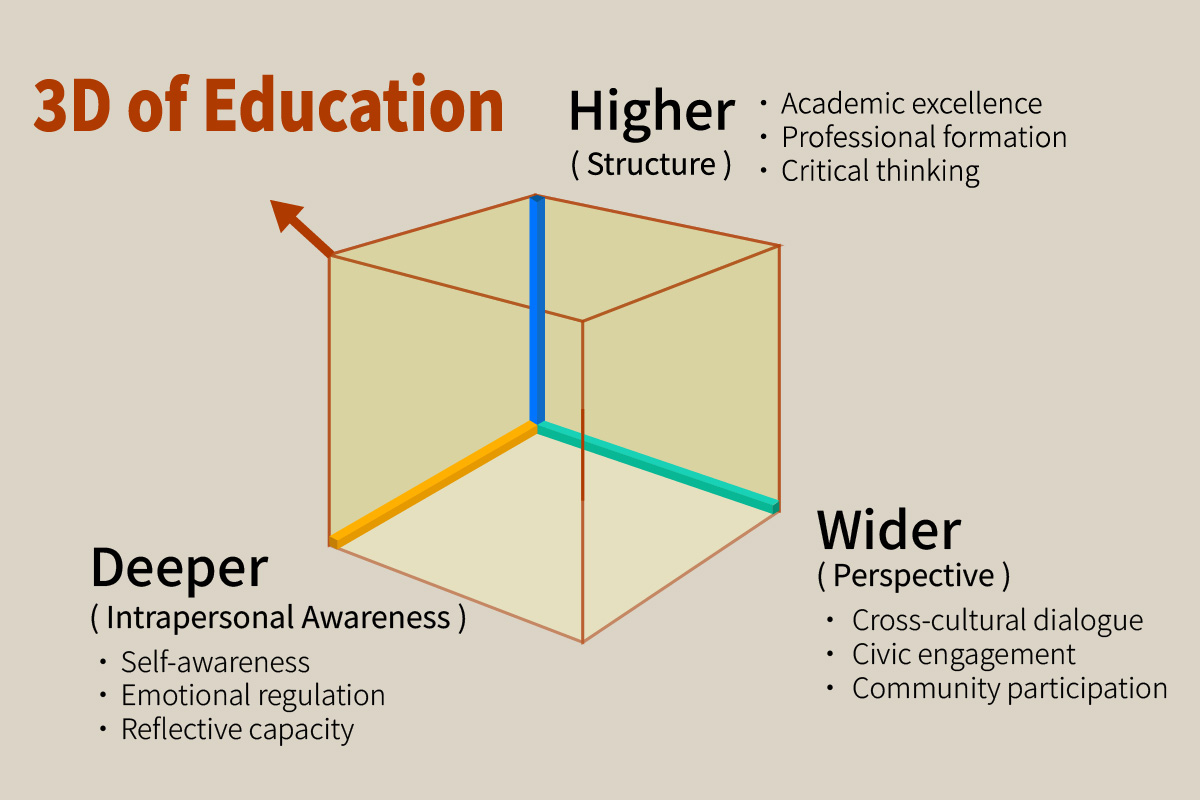
These three directions can be framed as a tri-dimensional model of education:
- Higher – structural cognition
- Wider – socio-cultural perspective
- Deeper – intrapersonal awareness
When these dimensions converge, education becomes more than the transfer of information. It becomes a co-generative process of becoming—a space where both the learner and the system are changed.
It is within this tri-dimensional framework that fairness, justice, and awakening can take discernible form: where the system learns from the human, and the human reshapes the system.
The Three Dimensions in Detail
Reframing “Higher”: Higher, Wider, Deeper
Traditional Higher Education emphasizes academic rigor and social mobility.
A just and holistic learning framework must also unfold in two additional directions: Wider and Deeper.
For education to be more complete, it needs to evolve across three dimensions:
- a space where structure engages cognition,
- a space where perspective meets culture and context,
- a space where depth develops intrapersonal awareness.
The Three-Dimensional Education Framework
I refer to this integrated orientation as Three-Dimensional (3D) Education.
| Dimension | Essence | Focus | Outcome |
| Higher Education | Structure / Structural Cognition | Academic excellence, professional formation, critical thinking | Systemic understanding, shared responsibility |
| Wider Education | Perspective / Socio-Cultural Perspective | Cross-cultural dialogue, civic engagement, community participation | Empathy, inclusiveness, collective vision |
| Deeper Education | Intrapersonal Awareness | Self-awareness, emotional regulation, reflective capacity | Resilience, coherence, sustained inner development |
The 3D Education framework can be summarized as follows:
- Higher provides structural cognition
- the capacity to organize knowledge, reason critically, and understand complex systems.
- the capacity to organize knowledge, reason critically, and understand complex systems.
- Wider develops socio-cultural perspective
- the ability to situate oneself within cultural, historical, and relational contexts.
- the ability to situate oneself within cultural, historical, and relational contexts.
- Deeper cultivates intrapersonal awareness
- the ability to recognize, regulate, and reflect upon one’s inner experience.
Together, these dimensions allow learning to move beyond narrow achievement and toward transformative development.
The Hidden Architecture: Individual × System × 3D Education
Education is not an isolated event. It unfolds in a dynamic field shaped by three interdependent forces:
- The Individual
- The System
- Three-Dimensional (3D) Education
Learning is neither merely personal nor purely systemic; it emerges through their interplay.
Together, these three forces form the architecture of Co-Generative Education, where:
- human intention,
- institutional structure,
- multidimensional learning
co-create meaningful environments of growth.
Co-Generative Education Map
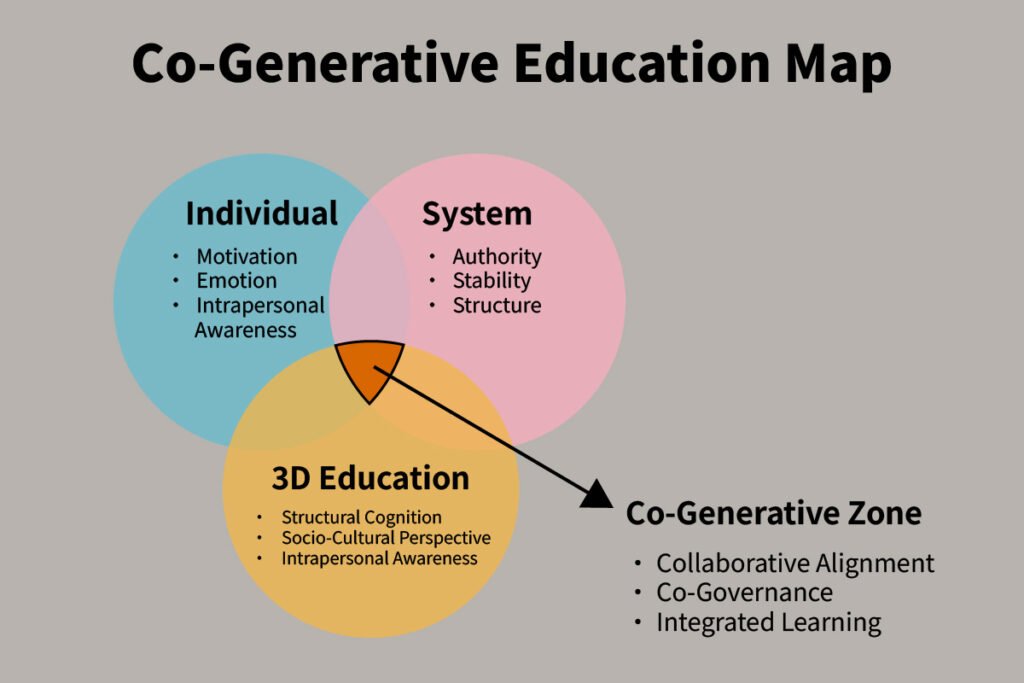
A holistic learning model where Individual, System, and Three-Dimensional Education converge to co-create meaning— enabling learning to evolve from achievement to development.
1. The Individual / Inner Agent
The Individual represents the inner psychological landscape of the learner.
Key dimensions include:
- Motivation – inner drive, purpose formation, orientation toward meaning
- Emotion – movement between wounding and healing; the authenticity of lived experience
- Intrapersonal Awareness – reflective capacity, emotional regulation, and internal coherence
In this view, the learner is not a rational component in a machine, but a living being shaped by story, vulnerability, and vision.
2. The System / Structure
The System provides the outer architecture that shapes what learning can become.
Key elements include:
- Authority – governance, institutional decision-making, and resource distribution
- Stability – safety, predictability, and rhythm that enable emergence
- Structure – frameworks, policies, and organized environments for learning
A healthy system offers ground—conditions in which creativity, participation, and even dissent can take root.
It allows individuals not only to adapt to structures, but also to contribute to and reshape them.
3. Three-Dimensional Education
The third force is 3D Education itself—how learning is designed, facilitated, and experienced.
It brings together:
- Structural Cognition (Higher)
- Understanding and organizing knowledge through coherent structures, conceptual frameworks, and analytical rigor.
- Understanding and organizing knowledge through coherent structures, conceptual frameworks, and analytical rigor.
- Socio-Cultural Perspective (Wider)
- Interpreting experience through awareness of cultural contexts, histories, power dynamics, and social relationships.
- Interpreting experience through awareness of cultural contexts, histories, power dynamics, and social relationships.
- Intrapersonal Awareness (Deeper)
- Cultivating self-awareness, emotional regulation, reflective capacity, and a stable inner orientation.
Learning becomes whole when it unfolds across all three of these dimensions, rather than privileging only one.ns:
The Center Overlap: The Co-Generative Zone
At the intersection of Individual × System × 3D Education, a new relational field emerges—the Co-Generative Zone.
This is the space where personal intention, institutional design, and multidimensional learning synchronize into a living ecology of co-creation.
4. Core Dynamics of the Co-Generative Zone
- Collaborative Alignment
- Resonance between personal purpose, systemic mission, and the cognitive–social–intrapersonal layers of learning.
- Resonance between personal purpose, systemic mission, and the cognitive–social–intrapersonal layers of learning.
- Co-Governance
- Authority is partially shared; dialogue supplements hierarchy; participants co-shape practices, norms, and decisions within defined scopes.
- Authority is partially shared; dialogue supplements hierarchy; participants co-shape practices, norms, and decisions within defined scopes.
- Integrated Learning Flow
- Structural cognition, socio-cultural perspective, and intrapersonal awareness interact to create cognitive–emotional–systemic coherence.
In this zone, integration of human and system is not compression but coherence—
not control, but responsiveness.
Co-Generative Education thus becomes a living ecology where:
- learning,
- development,
- governance
interact as one integrated process.
What “Co-Generative Education” Means
Co- = together, mutual, shared → relationship, partnership, interdependence
Generative = to bring forth, to enable development → life-giving, evolving
Literally, Co-Generative means:
“Creating together in a way that enables growth.”
Co-Generative Education envisions a learning ecology where:
- knowledge is co-created, not merely transmitted,
- students, teachers, institutions, and communities shape one another,
- learning shifts from teaching what to think towards cultivating how to coexist, co-create, and co-evolve.
It is the relational space where:
- Structural Cognition (Higher)
- Socio-Cultural Perspective (Wider)
- Intrapersonal Awareness (Deeper)
intersect and mutually activate.
In Practice: Traditional vs Co-Generative Education
The contrast between traditional and co-generative approaches can be outlined as follows:
| Dimension | Traditional Education | Co-Generative Education |
| Structure | Hierarchical, top-down | Collaborative and networked |
| Goal | Individual success | Collective flourishing |
| Teacher–Student Relation | Transmission of knowledge | Co-creation of understanding |
| Focus | Achievement | Process, connection, and transformation |
| Ethic | Competition | Reciprocity and coexistence |
This comparison is not intended to romanticize co-generative models or to demonize existing systems.
Rather, it clarifies a direction of movement:
- from one-way control → toward shared responsibility,
- from isolated performance → toward mutual flourishing,
- from education as sorting → toward education as co-creating a livable world.
Philosophical Core and Closing Reflection
Co-Generative Education understands learning fundamentally as relationship:
- between self and other,
- between individual and system,
- between knowledge and meaning.
It reframes fairness from a narrow focus on equal access into a deeper concern with mutual flourishing.
It sees education not as a closed institution, but as a living ecology in which justice, creativity, and human development can:
- support one another,
- question one another,
- and evolve together.
In condensed form:
- Higher represents structural cognition—knowledge frameworks and analytical rigor.
- Wider represents socio-cultural perspective—understanding across contexts, cultures, and power structures.
- Deeper represents intrapersonal awareness—reflection, coherence, and inner development.
Where these dimensions converge with the Individual and the System, meaningful learning emerges—a field where knowledge, empathy, and awareness grow together.
True justice in education arises when:
- knowledge supports empathy,
- systems support development,
- and learning becomes a bridge between the individual and the world.